
I. MISSION AND PURPOSE
At Dalhousie Public School, New Chandigarh, our mission is to nurture confident, articulate, and globally minded learners who view language as a foundation for communication, learning, identity, and personal growth. We are committed to building a joyful, inclusive, and culturally respectful learning environment where children from diverse linguistic backgrounds feel valued, heard, and supported.
We believe that strong English language proficiency opens pathways to global opportunities, while the active celebration of students’ home languages (Punjabi, Hindi, and others) strengthens their cultural identity, emotional well-being, and sense of belonging. Our purpose is to ensure that every learner grows as a balanced and proud multilingual communicator. While English remains the primary medium of instruction and interaction, we encourage families to preserve and develop their home languages through daily conversations, stories, and cultural practices.
In keeping with the principles of the IB PYP framework, DPS New Chandigarh recognizes language as a vital tool for learning, thinking, expression, and participation in a global society. We are committed to providing a language rich environment supported through books, periodicals, digital resources, and authentic opportunities for teacher and student writing.
We encourage learners to stay connected to their cultural heritage by learning the language of the state and honouring their mother languages. Recognising language is a powerful connector across the curriculum, our approach emphasises not only literacy development but also the meaningful application of language across transdisciplinary, interdisciplinary, and disciplinary learning.
At DPS New Chandigarh, every teacher is a language teacher, responsible for modelling, supporting, and enriching language development in every learning experience. This collective commitment ensures that our students grow into compassionate, informed, and internationally minded citizens who use language to engage thoughtfully with the world.
II. SCHOOL LANGUAGE PHILOSOPHY AND PROFILE
At Dalhousie Public School, we recognise that our students come from linguistically diverse homes, with Punjabi and Hindi being the most common family languages. While these languages form the foundation of students’ cultural identity, the school community, including parents, students and staff, collectively values English as the preferred language for communication and academic success.
Our language philosophy is rooted in the belief that language is central to learning, thinking, identity and global participation. We view language not only as a subject to be taught but as a tool that shapes inquiry, expression, creativity and reflection across all learning experiences.
Language as a tool for learning:
All teachers at Dalhousie Public School are language teachers. Every subject area becomes an opportunity to strengthen vocabulary, comprehension and communication in English.
Multilingual support and translanguaging:
While English remains the primary medium of instruction, Punjabi and Hindi are recognised as essential linguistic foundations. Teachers may use translanguaging in the early years to support understanding, gradually transitioning learners toward greater proficiency in English.
Language and identity:
Language is central to constructing identity and fostering intercultural understanding. We value each learner’s linguistic background as an essential part of their cultural pride, confidence, connection and personal expression.
Language and thinking:
We believe that students learn in, about and through language. Language supports deeper thinking, inquiry, creativity and reflection.
Language for life:
Language is viewed as a lifelong skill that nurtures critical thinking, empathy, confidence and global communication.
Inclusivity for diverse learners:
Recognising that not all students speak Punjabi at home, the school ensures equitable support through English as an Additional Language (EAL) assistance and scaffolding for learners from varied linguistic backgrounds.
This philosophy reflects our commitment to fostering confident, balanced, multilingual learners who thrive academically and socially in an interconnected world.
The following points summarize the language profile of students currently studying at DPS New Chandigarh:
Hindi is spoken at home by 46.5% of the families surveyed, making it the most common home language.
Punjabi is the home language for 36.4% of families, showing strong regional representation.
English is spoken at home by 13.2% of families, reflecting its role as a household language for some.
Other languages such as Ladakhi, Balti, Rongmei, Inpui, Manipuri, Pahari, and Urdu together account for 3.9% of home languages.
English is known reasonably well by 77.5% of students, making it the most widely understood additional language.
Hindi is spoken with proficiency by 62.8% of students, showing its continued importance beyond the home.
Punjabi is known by 39.5% of students, reflecting its cultural and linguistic influence.
Other languages including French, Spanish, Ladakhi, Balti, Rongmei, Inpui, Manipuri, Pahari, and Urdu are known by 6.2% of students.
22.5% of students are first-generation learners of English, meaning their parents are not highly proficient in English.
77.5% of students are not first-generation learners, indicating stronger English exposure at home.
English is the most preferred language for school learning, chosen by 76% of families.
English is the preferred language for communication with the school for 79.8% of families.
III. LANGUAGE OF INSTRUCTION
English is the medium of instruction and the primary language of communication across all classes.
Punjabi is taught as the second language to support cultural identity and as mandated by the Ministry of Education, Punjab.
Hindi is introduced as an additional language from EY3 onward.
International languages (French and Spanish) are offered from Grade 4 to promote multilingualism and intercultural understanding.
Language is taught through authentic, meaningful contexts, including units of inquiry and subject-based learning.
Classrooms are print-rich, with books, visuals and digital resources to nurture strong literacy skills.
Teachers model effective strategies for reading, writing, speaking and listening, reinforcing that every teacher supports language learning.
English is the official communication language.
Essential documents (parent surveys, key communications) are provided in English, Hindi and Punjabi for inclusivity.
Interactions with parents, visitors and auxiliary staff may occur in English, Punjabi or Hindi, depending on need.
Progression across grades:
Early Years:
- Focus on oral language through stories, rhymes and conversations in Punjabi, Hindi and English.
- Teachers use home languages along with English to support comprehension and comfort.
Primary Years:
- Balanced literacy in Punjabi, English and Hindi.
- Growing emphasis on vocabulary, reading comprehension and writing skills.
Middle and Secondary School:
- Development of advanced reading, formal writing, research skills and academic language proficiency.
IV. ESSENTIAL AGREEMENTS FOR THE TEACHING AND LEARNING OF LANGUAGE
At Dalhousie Public School, we believe that language learning is a shared responsibility across all subject areas. Our essential agreements ensure that every learner develops strong communication skills, appreciates linguistic diversity, and uses language as a powerful tool for thinking and inquiry. To achieve this, we agree that all students will be:
- Provided ample opportunities to listen, speak, read, and write across all areas of the curriculum.
- Taught literacy skills in meaningful contexts, connected to real-world learning experiences.
- Supported in using a wide range of strategies to comprehend, interpret, evaluate, respond to, appreciate, and construct texts.
- Taught through and with a variety of technological tools and information resources that enhance language learning.
- Encouraged to express themselves orally and in writing, using multiple media, formats, and authentic communication situations.
- Encouraged to share, refine, and develop their work in collaborative and social settings.
- Guided to understand that language is a tool for thinking, problem-solving, inquiring, and constructing meaning.
- Encouraged to maintain, develop, and value their home language(s) while appreciating the linguistic backgrounds of others.
- Provided opportunities to become proficient in more than one language, including English, Punjabi, and Hindi, strengthening multilingual competence.
- Exposed to a broad range of literature representing diverse cultures, perspectives, genres, and authors.
- Supported in developing a lifelong love for language and literature.
- Provided constructive, timely, and specific feedback from teachers and peers to support continuous growth in communication skills.
V. LANGUAGE AND PRIMARY YEARS PROGRAMME
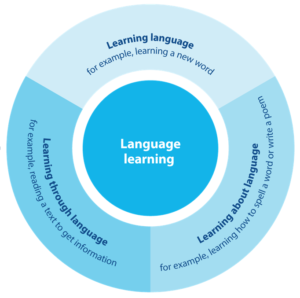
(Language in the PYP, IB, February 2019)
At Dalhousie Public School, our language policy is designed to nurture multilingual, culturally aware, and internationally minded learners. It reflects the transdisciplinary nature of the IB Primary Years Programme (PYP), ensuring that language development is both integrated across subjects and supported through dedicated language instruction.
Transdisciplinary language learning
Language is embedded across all areas of the curriculum, enabling students to enhance their communication skills while deepening their understanding of concepts in meaningful contexts. This approach ensures that language learning is not isolated but integral to every aspect of the students’ academic experience.
Standalone language instruction
In addition to integrated learning, language is taught as a standalone subject within the PYP. This provides focused opportunities for students to develop literacy skills systematically, including reading, writing, speaking, and listening. Combining both transdisciplinary and dedicated instruction ensures a well-rounded language education.
Early Years language acquisition
The school emphasizes early language development through Jolly Phonics. These initiatives build foundational skills in phonology, syntax, semantics, and pragmatics while promoting comprehension, expression, and confident communication. Early intervention ensures that students develop strong linguistic abilities from the outset of their education.
Subject Continuums (Also referred to as subject scope and sequence)
A comprehensive language Scope and Sequence, aligned with the IB framework, guides language learning across all grades. It incorporates all three language strands, receptive (listening and reading) and expressive (speaking and writing), ensuring a structured, cohesive, and globally benchmarked curriculum. This approach promotes consistency, continuity, and progressive skill development throughout a student’s learning journey.
Translanguaging and Multilingualism
The school actively promotes translanguaging and multilingual practices to enrich learning and support inclusion. Students are encouraged to engage with multiple languages through spoken and sung expressions, identity texts, bilingual materials, visual displays, and technology. This practice affirms cultural identity, strengthens linguistic competence, and fosters curiosity and respect for linguistic diversity.
Promoting International-Mindedness
English serves as the primary language for learning, collaboration, and global connection. At the same time, students’ home languages, including Punjabi and Hindi, are valued and celebrated. Language and Culture Days, diverse library collections, and digital resources support exploration of both local and global languages. Teachers link language learning to the IB Learner Profile, fostering attributes such as inquiry, critical thinking, communication, open-mindedness, care, and principled action.
Through this comprehensive approach, Dalhousie Public School ensures that all learners develop proficiency in multiple languages, remain connected to their cultural heritage, and acquire the communication skills and intercultural understanding necessary to thrive in a global society.
VI. LANGUAGE LEARNING IN CAMBRIDGE PROGRAMME
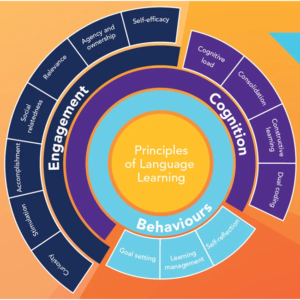
(Cambridge University Press (2022), Cambridge ELT Blog)
Language learning in the Cambridge Lower Secondary Programme is grounded in research-based principles that strengthen learner engagement, cognitive development and self-directed learning behaviours. The programme supports students in becoming confident communicators, critical readers and purposeful writers across subjects.
Engagement: building motivation and ownership
Teaching practices foster active, meaningful engagement with language by:
- Encouraging curiosity through inquiry-based tasks, open-ended questions and authentic texts.
- Creating a sense of accomplishment with scaffolded tasks that allow students to experience success.
- Promoting social connectedness through discussions, collaboration and peer feedback.
- Strengthening learner agency by giving students choices in reading materials, writing formats and modes of expression.
- Developing self-efficacy through visible progress tracking and personalised learning goals.
Cognition: strengthening thinking through language
Cambridge pedagogy emphasises cognitive growth by:
- Managing cognitive load through structured modelling, guided practice and gradually increasing complexity.
- Consolidating learning with spaced practice, retrieval routines and reinforcement of key language concepts.
- Encouraging constructive learning where students build understanding through exploration, analysis and reflection.
- Integrating dual coding approaches that combine text, visuals and multimodal resources to deepen comprehension.
- Embedding higher-order thinking by using language to infer, evaluate, analyse and synthesise information.
Learning behaviours: developing independent learners
Students are supported to become responsible, reflective and strategic language learners through:
- Goal setting that helps students monitor their progress and take ownership of their learning.
- Learning management routines such as planning, organising ideas, revising drafts and tracking vocabulary growth.
- Self-reflection practices that help learners identify strengths, areas for improvement and strategies that work for them.
A holistic approach across subjects
Language development is not confined to English lessons. In line with Cambridge Lower Secondary expectations, all subjects:
- Integrate discipline-specific vocabulary and communication skills.
- Provide opportunities to read, write, speak and listen for a range of purposes.
- Use inquiry, collaboration and problem-solving to connect language with conceptual understanding.
Offer exposure to global perspectives and diverse texts to build intercultural awareness and international mindedness.
VII. HOLISTIC LANGUAGE INSTRUCTION PRACTICES
At Dalhousie Public School, language is viewed as a foundation for communication, meaning-making, and conceptual understanding. Teachers support language development across the curriculum through the following practices:
- Using visual tools (e.g., graphic organizers) to strengthen comprehension of oral instruction
- Reinforcing oral explanations with written instructions
- Highlighting and revisiting subject-specific academic vocabulary
- Embedding visible thinking routines to support reasoning and metacognition
- Designing student-centered learning engagements that encourage discussion, questioning, and collaborative exploration
- Structuring tasks with clear scaffolds to provide equitable access and ensure successful learning experiences for all students
Oral Language: Listening and Speaking
Teachers value the diverse cultural and linguistic backgrounds of students and intentionally create opportunities for meaningful spoken communication. Through strategies such as dialogues, role-play, debates, storytelling, songs, and dramatization, students learn to:
- Build accuracy and fluency in English while respecting cultural nuances
- Engage in hands-on and experiential learning
- Communicate ideas confidently in varied social and academic contexts
- Develop openness towards diverse cultures and modes of expression
This approach nurtures confident communicators who appreciate multiple ways of sharing meaning.
Written Language: Reading and Writing
Reading and writing are essential components of learning in every grade level. DPS fosters a school-wide culture of literacy through:
- Immersive reading experiences including guided reading, independent reading, and daily read-aloud sessions
- A variety of texts including levelled readers, children’s newspapers, folk tales, and global literature
- Writing instruction that emphasizes meaning-making before mechanical accuracy
- Opportunities to write in multiple genres—narrative, informational, persuasive, poetic, and dialogic
- A writing process model: plan → draft → revise → edit → publish
These practices help students develop as thoughtful readers and expressive writers.
Viewing and Presenting
Students learn to interpret and create visual texts, understanding that images communicate ideas, beliefs, and values. Through exposure to advertisements, posters, films, websites, digital media, and student-created visuals, they learn to:
- Analyze how visuals influence opinions
- Recognize persuasive elements in media
- Use multimedia tools to express ideas creatively and appropriately
This strengthens visual literacy in a media-rich world.
Second Language instruction (Punjabi)
Punjabi is the mandatory Second Language from Grade 1 through Middle School.
Instruction in Punjabi focuses on oral, written, and visual communication, enabling students to:
- Develop proficiency in the regional language
- Access local heritage through stories, poetry, music, festivals, and traditions
- Build strong bilingual foundations that support linguistic transfer to English
- Develop pride in their cultural identity and a deeper understanding of their community
Classroom environments include Punjabi labels, anchor charts, and resources that reinforce language exposure.
Third Language instruction
Early Years 3 (EY3)
- Hindi is introduced as a compulsory third language, focusing primarily on oral development through songs, rhymes, stories, and picture books.
Grades 1–3
- Hindi remains the compulsory/mandatory third language, with structured learning in reading, writing, speaking, and vocabulary development.
Grades 4–Middle School
- Students select a third language from the following:
Hindi, French, or Spanish. - The curriculum for each language includes outcomes across oral, visual, and written strands.
- Students learn about cultures associated with their chosen language, promoting intercultural appreciation.
Home language support
The school is committed to nurturing international-mindedness by valuing the languages, cultures, and identities that students bring from home. We follow a tri-literacymodel that encourages students to develop strong proficiency in three languages while maintaining meaningful connections to their linguistic and cultural roots.
Home language support strengthens the development of the language of instruction and additional languages, while also enriching intercultural understanding among students and peers. This approach ensures that learners retain pride in their heritage and remain connected to their home communities and education systems.
To promote and sustain home language development, the school:
- Encourages parents to read, converse, and engage with children in both English and their home language (Punjabi/Hindi).
- Promotes Punjabi in the early years through oral storytelling, songs, rhymes, and exposure to regional literature, poetry, and folk traditions to build cultural identity.
- Organizes celebrations such as Hindi Diwas, International Mother Language Day, Diwali, Baisakhi, and Independence Day, providing platforms for poems, songs, and cultural expressions in multiple languages.
- Hosts Parent storytelling sessions, inviting parents and grandparents to share folk tales and rhymes in their home languages, with teachers helping students connect these experiences to English learning.
The aim of all home-language initiatives is to develop a balanced linguistic foundation that includes:
- Conversational fluency
- Strong listening and comprehension skills
- Critical literacy and reading proficiency
- Writing skills and academic language
Through these practices, the school ensures that every learner’s home language is respected, valued, and actively supported as an essential part of their identity and overall language development.
VIII. SUPPORT FOR LANGUAGE DEVELOPMENT
Dalhousie Public School is committed to providing comprehensive and inclusive support that enables all students to develop strong language skills across English, Punjabi and additional languages. Support systems ensure that every learner progresses confidently without segregation or withdrawal from regular classroom learning. All assistance is embedded within mainstream classrooms through differentiated instruction, co-teaching and targeted scaffolding.
Inclusive intervention and student support
Students who require additional language support are discussed collaboratively during Student Support Meetings involving classroom teachers, the English lead, academic coordinators and learning support staff. The team identifies needs, sets achievable goals and monitors progress through regular follow-ups. Interventions remain classroom-based and may include:
- modified instructional strategies
- visual aids, sentence frames and structured vocabulary scaffolds
- peer-assisted learning
- guided reading and writing support
- targeted language routines during lessons
All plans remain flexible, responsive and aligned with individual growth.
Library support for language enrichment
The school library plays a central role in language development. The librarian collaborates with teachers to:
- conduct read-alouds, research lessons and genre-based reading sessions
- support students in selecting books aligned to their reading levels and interests
- maintain a rich collection of English, Punjabi, Hindi and world-language texts
- provide digital resources and age-appropriate reference materials
The library follows a structured weekly timetable to ensure equitable access for all classes.
Technology integration in language learning
Technology is intentionally integrated to enhance communication and literacy. Students use:
- tablets and computers for digital reading, writing and research
- tools such as word processors, graphic organizers, audio-recording apps and presentation software
- interactive boards for shared reading, phonics and vocabulary-building activities
Digital platforms also support multilingual literacy, helping students explore Punjabi and Hindi scripts through guided apps and e-resources.
Assessment and monitoring
Assessment at Dalhousie Public School is continuous, inclusive and growth-oriented, recognising that students develop language skills at their own pace based on their linguistic backgrounds.
Key assessment practices include:
- an Intake Language Profile for each new student, capturing home language, English level and exposure to Punjabi/Hindi
- continuous assessment across reading, writing, speaking, listening and vocabulary
- recognition of mother tongue development as an essential part of overall language growth
- diagnostic, formative and summative assessments that remain flexible and adapted to learner needs
- growth-based (ipsative) assessment comparing a student’s current progress with their earlier work
- performance-based tasks such as storytelling, drama, presentations, recitations and project work
- appropriate adaptations for additional-language learners to ensure fair opportunities to demonstrate understanding
Assessment practices ensure that no child is limited or compared unfairly because of their language background. Every learner’s progress is acknowledged through a supportive, strengths-based approach.
IX. ROLES AND RESPONSIBILITIES
Role of the School
- Provides opportunities for learning multiple languages.
- Ensures availability of teachers and resources to support language development.
- Offers ongoing professional development for educators to enhance skills and competencies.
- Identifies students needing additional language support and provides targeted interventions.
- Supports parents of first-generation learners by communicating in their home language, where possible.
- Plans curriculum, inquiry trails, and parent meetings to ensure no community member is excluded due to language barriers.
- Celebrates linguistic diversity through class activities, assemblies, and cultural events, nurturing pride in home languages and the host country’s language.
Role of the Library
- Provides resources that support academic requirements and student interests.
- Encourages students to use the library for research, reading, and issuing books.
- Facilitates literary events and celebrations in collaboration with language teachers.
- Promotes a strong reading culture through programmes for both students and staff.
- Library committee considers student and teacher preferences when adding new resources.
Role of Teachers and Staff
- At DPS New Chandigarh, all teachers are language teachers, embedding language learning across subjects.
- Teachers model clear, confident, and accurate language use.
- Integrate subject-specific academic vocabulary in lessons.
- Strengthen communication skills through purposeful speaking, listening, reading, and writing.
- Plan student-centred activities that promote dialogue, reasoning, and collaboration.
- Provide scaffolding, structured tasks, and guided practice to ensure student success.
- Differentiate instruction to meet diverse language needs, including additional support in English.
- Select resources that uphold equality, diversity, inclusion, and academic rigour.
- Receive regular training in phonics, early literacy, inquiry-based strategies, differentiation, and EAL methodologies.
- Co-plan with the English lead to integrate subject-specific vocabulary.
- Library staff support teachers and students with appropriate book selection, multilingual resources, and promoting reading culture.
Role of Parents and Community
- Act as active partners in children’s language growth.
- Maintain a positive attitude towards the use of mother tongue, especially in early years.
- Read with children in English or home language and reinforce phonics and vocabulary practice.
- Attend curriculum familiarisation meetings to understand the school’s languagephilosophy.
- Support consistency with chosen language options and maintain communication with the school for additional support.
- Partner with local libraries, cultural associations, and storytellers to create authentic language experiences.
- Volunteer as storytellers to share cultural narratives in home languages.
Role of Students
- Communicate in English inside and outside the classroom, except during lessons for other languages.
- Show respect towards peers who may speak with home language influence.
- Listen to presentations, watch age-appropriate media, and explore digital content in the target language.
Read texts and literature in English and other languages to strengthen comprehension and linguistic awareness.
X. LINKS TO OTHER POLICIES
Admission policy
- English is the primary language of instruction; therefore, assessing language proficiency is a key part of the admission process.
- Admission cannot be denied to Primary grade students solely due to limited reading or writing skills.
- Students’ proficiency in English and other offered languages is considered to ensure they can access the curriculum effectively.
Inclusion policy
- Limited language proficiency is not a reason for exclusion.
- Support is provided to help students reach age-appropriate language and academic levels.
- The Learning Support Unit assists students with learning gaps and documented learning needs, including language-related challenges.
Assessment policy
- Language learning is assessed through both formative and summative methods.
- Feedback from assessments is shared with students and parents to guide learning.
- Goals are set collaboratively with students and parents during early school conferences.
- Remediation and targeted support are provided according to each student’s needs.
Academic integrity policy
- Language skills enable students to access knowledge, express ideas clearly, and develop both cognitive and cultural awareness.
- Teachers model academic integrity by assessing language work fairly and transparently.
- Students are guided to understand the principles of honesty and integrity in learning, including appropriate use of sources, with explanations provided in their home language when needed, especially in early years.
Other school practices
- Library and resource policy: Students use the library to explore multilingual texts, develop research skills, and engage in reading programmes that support language growth.
- Co-curricular activities: Languages are integrated into cultural events, assemblies, and storytelling sessions to provide authentic learning experiences.
- Parent engagement policy: Parents are encouraged to support language learning at home, participate in curriculum familiarisation sessions, and volunteer as storytellers or resource contributors.
- Teacher professional development policy: Educators receive ongoing training in literacy, language acquisition, and differentiated instruction to meet the diverse language needs of all students.
XI.REVIEW OF THE POLICY
The DPS New Chandigarh Language Policy came into effect from August 2025 and will be reviewed every two years or earlier as needed by the policy review committee and the Pedagogical Leadership Team (PLT).
Policy creation and first review : August 2025
Second iteration: October 2025
Third iteration: November 2025
Framed by: Jai Brar, Zenia Gonzalez, Sukirat Singh, Yashdeep Kaur, Prabhneet Kaur, Vani Khanna, Parmjit Kaur, Vaibhav Sharma
Reviewed by: All teaching staff, (student name), (parent name) and PLT
Next Review: Academic session- 2027-28 (Or as required)
XII.REFERENCES
Cambridge University Press. (2022, April 22). Principles of language learning [Infographic]. Cambridge English Language Teaching Blog. https://www.cambridge.org/elt/blog/2022/04/22/how-to-rise-to-students-learning-challenges/principles-of-language-learning/
International Baccalaureate Organization. (2008, April). Guidelines for developing a school language policy. Online Curriculum Centre. https://www.pghschools.org/cms/lib/PA01000449/Centricity/Domain/809/guidelines%20for%20writing%20a%20languag%20epolicy.pdf
International Baccalaureate Organization. (2008). Learning in a language other than mother tongue in IB programmes: Primary Years Programme, Middle Years Programme and Diploma Programme. https://www.ibo.org
International Baccalaureate Organization. (2011). Language and learning in the IB programmes. https://www.ibo.org
International Baccalaureate Organization. (2018). Making the PYP happen: A curriculum framework for international education (Updated edition). https://www.ibo.org
International Baccalaureate Organization. (n.d.). Language scope and sequence. https://www.ibo.org